IPTV Spain: Best Services With Channels and Pricing
For UK viewers who want Spanish or British live channels, the safest fit is a service that can confirm rights for the channels and devices they need. IPTV Spain uses an internet connection, but a player is not a channel subscription. Choosing the wrong offer can mean paying for channels that are unavailable or not authorized for distribution.
An IPTV player is an app or device interface that plays streams from a separately supplied service and does not itself grant channel rights. Viewers may want Spanish channels, UK channels, or football, and the right option depends on what they watch and where they watch it.
This page helps UK viewers compare legitimate options without promising a particular lineup. Check channel rights, price terms, and device support before subscribing. Treat a channel list as a starting point, not proof that a provider has permission to distribute every program.
IPTV Spain: Which Service Fits UK Viewers?
For regular live viewing, choose a licensed package that confirms the desired Spanish and UK channels; for occasional catch-up, official broadcaster apps may be the simpler fit. The right service depends on whether live television, sport, or a limited set of programs matters most.
A name on a sales list does not guarantee current availability or distribution rights. The Spanish IPTV service comparison can help identify package features, but a comparison is not proof of any provider’s permissions.
Spanish and British channels to check
Examples of Spanish channels include Antena 3, Telecinco, and RTVE. UK examples include BBC One, ITV, and Channel 4. A provider may carry some, all, or none of these, and the lineup can differ by location and subscription.
Free IPTV in Spain is safest through official free-to-air broadcasts or broadcaster services, rather than unofficial free playlists. UK IPTV in Spain depends on the provider’s distribution rights and each broadcaster’s availability rules. Some programs may be limited to certain countries even when a channel is listed.
For the best IPTV for UK TV in Spain, the practical choice is a licensed service that confirms the exact UK channels in writing. Official broadcaster apps may suit occasional viewing better, especially when only catch-up programs are needed.
Live football and catch-up rights
Football rights are specific to competitions, seasons, and fixtures. LaLiga is one example of a Spanish competition, but a general sports label does not show that a service can carry its matches. Ofcom regulates broadcasting in the UK, while rights still depend on the relevant content and territory.
Catch-up access also varies. Check how long programs remain available and whether the service includes replay or only live streaming. A channel may be available live without every program being offered later.
- Write down the Spanish and UK channels wanted.
- Confirm live sports rights for the competition and fixtures.
- Check the catch-up period for missed programs.
- Confirm the number of simultaneous connections included.
Check the named competition and a specific fixture before paying, since a general sports label does not confirm match rights.
How Should an IPTV Price Be Compared?
A fair monthly comparison starts with the total amount charged divided by the billed months, then checks renewals and simultaneous devices. Paying for IPTV can be worthwhile when wanted channels are licensed, watched regularly, and available on supported devices; it may not suit someone who needs only occasional catch-up.
Plans can cover 3, 6, or 12 months. IPTV plans in euros should be compared by the full upfront charge, not just a lower monthly equivalent. The same calculation helps compare streaming services with different billing periods.
Monthly billing and longer terms
Divide the full charge by the number of billed months to find the monthly equivalent. Then check whether the renewal uses a different price. A lower figure per month can still require a larger payment at checkout.
A multi-month plan may reduce the monthly equivalent while increasing the amount paid upfront. It also raises the risk of losing value if access or service quality changes during the term. A short plan can cost more per month but limits the amount committed in advance.
What a quoted price should clarify
The headline price is only one part of the cost. Check how many simultaneous connections are included, whether renewal is automatic, and what cancellation and refund terms apply. Extra fees can also change the total.
Write down the full charge and the period it covers before comparing plans. A listed monthly amount may describe an average rather than the amount taken at checkout. Confirm whether taxes, setup costs, or payment fees are added.
Support and access terms matter to value, too. A low price is not useful if the service does not support the household’s devices or the needed channels. Keep the comparison focused on the plan that meets those needs, rather than channel totals alone.
Before paying, save the checkout terms showing the total charge, renewal amount, and cancellation conditions.
What Setup Does IPTV Need in Spain?
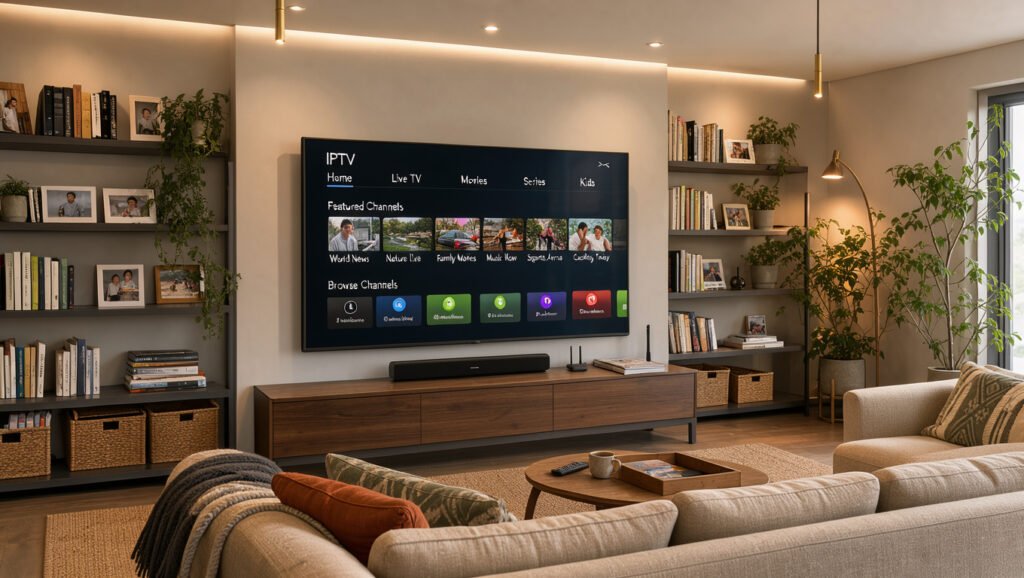
A compatible device, a stable internet connection, and credentials from a service are the basic IPTV setup. The player opens supplied streams, but it does not provide channels by itself. Actual playback depends on the stream, home network, and other devices using the connection.
UK access figures show why a fast connection cannot be assumed in every household. In 2025, 5% of people aged 16 and over in the UK lived in a household with no internet access, and 48,000 premises lacked decent broadband, defined as at least 10 Mbps download and 1 Mbps upload.
Ofcom’s research on household connectivity reports that 5% of UK residents aged 16 and over do not have home internet access. Decent broadband is a threshold, not a promise of smooth streaming, especially when several people share the network.
Broadband speed and household access
In 2023, 85% of UK TV households had access to IPTV, while 87% had an internet-enabled primary TV set. In that year, 18% of households used the internet exclusively to watch television, and 17% relied solely on digital terrestrial television, or DTT.
A move to IPTV-only television in the UK by 2034 would require suitable physical infrastructure, the skills to use devices, and affordable services. Those needs matter for households where broadband is weak, expensive, or unfamiliar. Internet access alone does not establish that a home can stream reliably.
Performance depends on video quality, household use, Wi-Fi conditions, and network congestion. High-definition video and several active streams place more demand on a connection than one lower-resolution stream. A wireless signal can also weaken between the router and television.
Devices, players, and connection steps
Compatible device examples include smart TVs, Fire TV, Android TV, MAG set-top boxes, iOS and Android phones or tablets, and PCs. IPTV Smarters Pro and TiviMate are examples of IPTV players. Compatibility depends on the service and device operating system, so a familiar app name does not ensure support.
Some services provide credentials through M3U or Xtream Codes. A set-top box may connect to the router by Ethernet and to the TV through HDMI or AV. The general IPTV setup guidance also stresses checking device support and connection stability.
- Confirm that the provider supports the device and its operating system.
- Install the chosen IPTV player or connect the set-top box.
- Enter the service credentials supplied with the subscription.
- Connect by Ethernet or suitable Wi-Fi, then test playback.
Test the connection where the TV is used and when other household members are online, not only beside the router at a quiet time.
How Can Viewers Verify IPTV Legality and Reliability?
IPTV itself is a delivery method; legality depends on whether the provider has permission to distribute each channel or program. The same technology can carry authorized broadcasts or streams that lack rights, so the delivery method alone does not establish legality.
An IPTV player does not check distribution rights. IPTV blocked in Spain is not a blanket description of the technology: an individual service or stream may be restricted, unavailable, or taken offline because of licensing or enforcement.

Content rights matter more than the delivery technology
Rights can differ by channel, program, competition, and country. A provider’s access to one program does not prove permission for every channel it advertises. Viewers should judge the specific content being offered, rather than treating a large lineup as evidence of authorization.
An international operation shut down illegal streaming services used by millions worldwide. Authorities suspected 31 group members of unauthorized pay-TV distribution, illegal access to IT systems, computer fraud, and money laundering.
Authorities also suspected the group concealed illicit revenue amounting to several million euros per month through cryptocurrency investments and shell companies. The Eurojust account of the international operation shows that illegal services can be disrupted. The case does not determine an individual viewer’s legal position.
Provider transparency, privacy, and service limits
A provider’s business identity and written terms help distinguish a real service from a sales page with no clear accountability. Use these checks before sharing payment or personal details:
- Identify the legal business behind the service.
- Ask for evidence of distribution rights for the content offered.
- Read the renewal and cancellation terms.
- Check what personal and payment data the provider collects.
Privacy terms should explain how account details are stored and used. A provider that gives no clear business identity or data policy leaves customers with little information about who handles their details if service stops.
A VPN does not make unauthorized content lawful or guarantee anonymity. Internet activity may still be associated with an account or connection, and a VPN does not establish that a stream is licensed.
Service access can change if rights expire or enforcement action takes place. A polished interface and responsive sales team do not replace evidence of authorized distribution. If a provider cannot clearly explain its content rights and business identity, do not treat a polished channel list as proof of legitimacy.
Conclusion
A sensible IPTV choice starts with verified channel rights and clear terms, not the largest advertised lineup. The service should fit the viewer’s devices and internet connection, while stating its full price and renewal conditions in plain language.
Before subscribing, check the provider’s current plan details and written channel coverage. Confirm the exact channels, total charge, renewal conditions, and device support in writing before making a payment.