IPTV Trial Subscription 2026 Guide for U.S. Viewers
An IPTV trial can show whether a stream works in a home, but it cannot establish whether the provider has permission to distribute its programs. For UK viewers, that distinction matters before any payment details are shared. Internet-delivered television can offer another way to watch, but a trial only shows how it performs on the viewer’s own connection and device.
This IPTV trial subscription 2026 guide compares Lux IPTV, Moly IPTV, and Boss IPTV using their advertised trial and subscription details. It also explains what to test, how to check terms, and why viewing access and content rights are separate questions. A service that loads smoothly on one screen may behave differently on another.
Before paying, readers should check whether the service can identify its licensed provider and explain its cancellation terms. Traditional cable satellite services and mainstream streaming platforms may make rights information easier to confirm, though viewers should still compare what each offers. Treat clear terms and verifiable content rights as more important than a large advertised channel count.
What Does an IPTV Trial Let You Test?
A trial gives a viewer temporary access to judge the service on the device and connection they actually use. IPTV, or internet protocol television, delivers video over the internet rather than through an aerial or satellite dish. The delivery method describes how programs reach a screen, not who has permission to distribute them.
An electronic program guide (EPG) is the on-screen schedule that shows programs and channel listings. During a trial, a viewer can check whether channels load, whether schedules appear, and whether on-demand content plays. A working EPG is useful, but it does not show whether listed programs are licensed.
Trial access is usually time-limited, from a few hours to a few days. The length and included content can differ between providers, and access may end automatically or require cancellation. Viewers should confirm the expiry time and included features rather than assume every listed channel will be available.
IPTV itself is neither automatically authorized nor automatically unauthorized. Whether an internet-delivered service is lawful depends on the content rights and the law where the viewer lives. The same streaming technology can carry programs from a licensed provider or content distributed without permission.
A useful introduction to how IPTV delivers television over the internet can help explain the basic technology, but U.S.-focused comparisons do not establish UK rights or terms. For UK viewers, those questions require a separate check. A trial can help assess access and playback, not the legal status of the catalog.
Test the service on the screen used most often, because the same stream may behave differently across devices and connections. Note whether a live channel starts promptly and whether the EPG shows current listings. A working stream confirms playback, not permission to distribute the program.
How to Compare an IPTV Trial Subscription 2026
A short, planned test is more revealing than browsing a long channel list for a few minutes. A practical first check takes about 15 minutes, though viewers should allow more time for peak-hour testing. The goal is to judge channels and streaming quality that matter at home.
Test the channels and picture quality
Choose at least three channels, including one the household watches regularly, and play each for at least five minutes. Test one on-demand title as well. Check picture stability, audio sync, loading time, and how quickly the app switches between channels.
A channel appearing in a list does not prove it plays. Open the EPG and compare the schedule with the program actually on screen. For sports, note whether the picture stays clear during fast movement and whether the stream remains steady through a busy moment.
- Check the channels the household actually watches.
- Play one on-demand title from start to finish for several minutes.
- Run a quiet-time test when fewer people are watching.
- Repeat at an evening peak or during a busy sports event.
Check peak-time performance and support
Compare quiet-hour playback with an evening or busy-event test. Server congestion can affect streaming even when a home connection seems fast. A second test helps show whether the same channels remain stable when viewing demand rises.
Ask customer support a real question about a channel, access limit, or cancellation step. A useful reply should address the question directly, not just send a sales message. For a broader checklist on how to test an IPTV trial before subscribing, focus on the same device and viewing hours used at home.
Write down the time, channel, and problem when something fails. A fault on one feed may be different from a wider service outage, and a record helps support investigate. Record what fails and when, so a single stream fault is not mistaken for a service-wide problem.
Which Trial Terms Should You Check Before Signing Up?
The trial’s end date and any future charge should be clear before a viewer submits payment details. Confirm three points in writing: the trial length and price, the cancellation steps and deadline, and what happens to payment details or access afterward. A card-required trial may renew automatically.
Users should understand the offer before entering personal or payment information. A provider should state whether access stops at expiry, converts to a paid subscription, or requires a separate cancellation. Clear wording makes it easier to decide whether the trial suits the household.
- What does the trial cost, including any service fee?
- Does the trial renew automatically, and what is the next charge?
- How can the viewer cancel, and what is the deadline?
- What personal or payment data is retained after the trial?
Save the offer page and confirmation message, including the trial start date and any renewal details. Keep a copy of the cancellation instructions somewhere easy to find. Screenshots can help, but avoid capturing login details or payment data that could be exposed if the image is shared.
A provider’s failure to answer clearly is a reason to pause, not proof by itself of wrongdoing. It may reflect poor support, unclear business processes, or a deliberately vague offer. In each case, a viewer can wait rather than risk a charge they did not expect.
Check whether cancellation must happen through the provider, an app store, or another payment service. The route can affect which account settings matter and when the request takes effect. Keep the confirmation and cancellation instructions somewhere accessible until the trial has ended.
How Should You Test Streaming Quality and Reliability?
A speed test is only a starting point because stream quality also depends on Wi-Fi, device load, and network congestion. As a general rule of thumb, one HD stream commonly needs about 5 Mbps, while one 4K stream commonly needs about 25 Mbps. These figures are not guarantees.
Check speed and connection stability
Broadband speed measures how much data can move at a moment; stability reflects whether the connection keeps moving it without interruptions. A fast result cannot prevent buffering if Wi-Fi drops, another device uses the network, or the IPTV app struggles on its device.
Run tests on the actual television or streaming device when possible, not only on a phone near the router. Check how long a channel takes to load, whether resolution changes, and whether audio stays in sync. Fast internet is helpful, but consistent delivery matters too.
Compare quiet hours with busy viewing times
Repeat playback during a quiet period and at the time the household normally watches. Evening use, live sports, or other busy events can expose problems that a daytime test misses. Keep the channel and viewing device consistent so the comparison is useful.
Other household traffic can change the result. Video calls, game downloads, and multiple streams compete for capacity, while device performance and server congestion may add delays. A wired connection or strong Wi-Fi can help isolate a local network issue, but cannot guarantee provider performance.
Note buffering, sudden resolution changes, audio delay, and slow channel loading. If the problem happens only on one device, the local setup may be involved; if it repeats across devices and times, the service may be the cause. Judge a service on repeated playback at the times you normally watch, not on its best moment.
Which Devices and Apps Can You Use?
Compatibility is a two-part check: the device must run the app, and the app must accept the provider’s access method. Lux IPTV lists Smart TVs, Android phones and tablets, Apple TV, iPhone, Chromecast, MAG boxes, STB Emulator, and Amazon Firestick as compatible in 2026.
Moly IPTV lists Smart TVs, Amazon Firestick and Fire TV, Android TV and mobile devices, iPhone and iPad, Windows PCs, Macs, and MAG boxes in 2026. It says the service works with IPTV Smarters and TiviMate, among other apps. These are provider-stated compatibility lists, not a promise of stable playback.
Check the television or streaming device
Confirm the exact model and operating system, especially on an older Smart TV. App availability can differ by device and operating system, even when two televisions share a brand name. A device may also lack the memory or updates needed for smooth playback.
Test on the screen used most often, rather than relying on a phone installation as proof that the living-room setup will work. Some users want to cast from a mobile device, while others prefer a dedicated player or built-in television app. Each route can behave differently.
Confirm which IPTV apps the provider accepts
An IPTV app is a player, not the provider itself. An app may install successfully but still reject a provider’s login format. Confirm that the service accepts the chosen app and that the device’s official store offers it.
Ask customer support to confirm the exact device model and app before committing to a longer term. Compatibility does not prove the service’s catalog is licensed, and it does not guarantee each channel will work. Confirm the exact device model and app with support before paying for a longer plan.
How Do M3U, Xtream Codes, and EPG Setup Work?
Setup usually begins when the provider sends login details in a format the chosen IPTV app accepts. An M3U playlist is a link-based channel list, while Xtream Codes is a login method using details supplied by the provider. The app needs a format it supports.
An EPG adds program schedules to compatible channels. After login, the guide may take 30-90 seconds to populate. A blank guide at first does not always mean access has failed, but a guide that remains empty may need support or correct EPG details.
- Install a player from the device’s official store.
- Choose the provider’s supported M3U playlist or Xtream Codes option.
- Enter the supplied login details privately.
- Allow the EPG to load before judging the channel schedule.
- Test a few live channels and one available on-demand title.
Use only the login details sent through the provider’s verified channel. A common mistake is posting a screenshot in a public forum to ask for help. The image may expose a playlist link or credentials that another person could use.
If a login fails, check for typing errors and confirm the selected login option matches the details received. A playlist link and Xtream Codes credentials are not interchangeable. Do not paste private details into unrelated websites or send them to strangers offering setup help.
Keep the message with login details in a private place, and delete any accidental public copy. If help is needed, share only the information support requests through its verified channel. Do not send credentials to anyone who is not the provider’s verified support channel.
What Does a Lux IPTV Trial Include?
Lux IPTV advertises a 1-day trial that includes access to the live channels, movies, and series in its packages. The offer lets viewers test playback, catalog navigation, and whether the service works on their own setup. Trial access does not establish that every listed program is available or licensed.
Trial access and advertised catalog
In 2026, Lux IPTV advertises more than 20,000 live channels and more than 150,000 movies and series. Those are catalog claims, not proof of availability, stream quality, or rights. A viewer should test a few specific programs rather than judge the offer by its totals.
Lux IPTV recommends at least 30 Mbps for HD/4K viewing in 2026. That is the provider’s stated recommendation, not a guarantee that every stream will run at that quality. The home network, device, and available source stream can affect the result.
Device limits, plans, and refund terms
Lux IPTV says an account can be installed on multiple devices but used on only one device at a time. That limit does not mean simultaneous multi-screen viewing. Households wanting two screens at once should treat the distinction as important.
Lux IPTV lists 1-, 3-, 6-, 12-, and 24-month subscription terms. Its 72-hour refund condition applies to the 3-, 6-, 12-, and 24-month subscriptions, not the 1-month term. The condition is separate from the advertised trial, so viewers should not confuse the two.
Before buying, compare the cancellation window with the date of purchase and keep the confirmation. A refund condition may have limits beyond the headline period, so the checkout wording matters. Save the stated refund deadline and confirm the exact terms at checkout before purchasing.
How Does Moly IPTV Compare on Trial and Price?
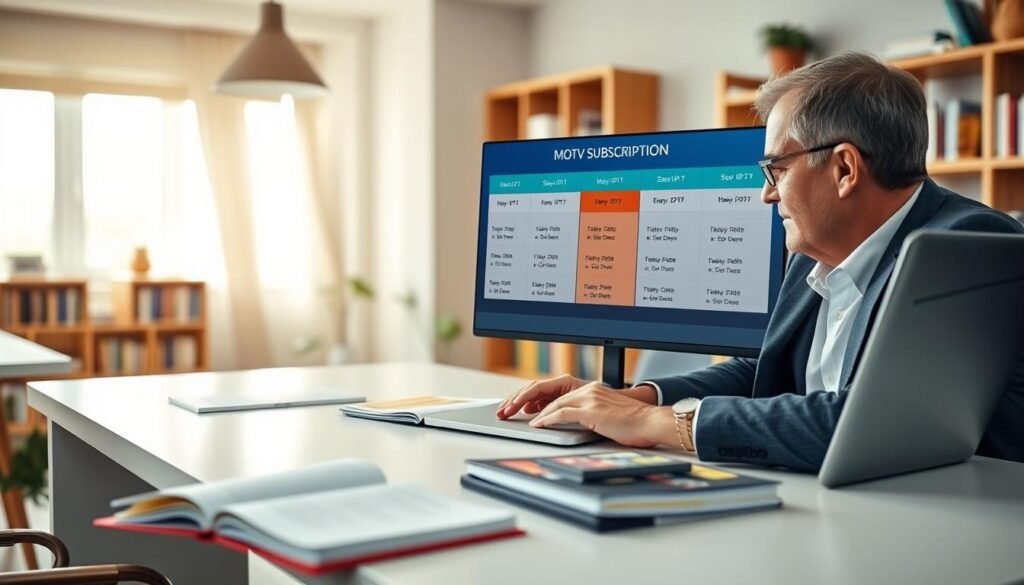
Moly IPTV’s shortest listed plan is 1 month, priced at $19.99 in 2026. Its published price ladder also includes $29.99 for 3 months, $45.99 for 6 months, $69.99 for 12 months, and $99.99 for 24 months. A longer term lowers the listed monthly equivalent but asks for a larger upfront commitment.
Published subscription prices
The five terms provide a direct way to compare commitment length, but price alone does not show whether the service suits a viewer. A short plan may limit exposure while someone checks playback and support. A long plan may cost less per month while creating more risk if the service disappoints.
Check the currency, payment fees, renewal rules, and refund terms on the checkout page. Published prices do not prove the catalog is licensed or that every channel remains available. The viewer should weigh the commitment against the service’s stated conditions.
Trial availability and plan content
Moly IPTV says free trials are available occasionally rather than on a fixed schedule, and advises asking support whether one is currently available. That means trial access cannot be assumed as part of every offer. Ask for the exact expiry and included content if a trial is offered.
In 2026, Moly IPTV advertises more than 33,000 live channels and more than 500,000 movies and series on demand, with streams up to 4K where available. It says every plan includes the same content, with plan length as the only difference. Catalog size and price do not verify ongoing availability or content rights.
Moly IPTV recommends a stable internet connection of 10 Mbps or more. The stated figure is a provider recommendation, not a guarantee of quality on every device. Ask support whether a trial is available now before treating it as part of the offer.
What Do Boss IPTV’s 72 Hours Let You Test?
A 72-hour trial offers more time for repeat tests than a one-day window, if the access works as advertised. Boss IPTV advertises a 72-hour free trial with live TV, on-demand movies and series, PPV options, an EPG, and available HD and 4K streams in 2026.
A 3-day IPTV free trial gives viewers time to test different viewing periods, but its value depends on what access is included. Try a live channel, an on-demand title, and any PPV option that matters to the household. Check whether the EPG shows usable program listings.
HD and 4K availability should be checked on the actual device, because a label in an offer does not guarantee every feed uses that resolution. Compare daytime playback with evening viewing. Sports or other busy events can reveal whether a stream holds steady when demand rises.
Boss IPTV says trial access requires no credit card and carries no contract or commitment during the trial. A no-card offer can reduce the chance of an automatic payment, but it does not prove that the content is licensed. Viewers should still check the service’s rights and other terms.
Boss IPTV says trial login details may arrive in M3U or Xtream Codes format. Keep those details private and check that they work in the chosen player. If a feature is important, test it during the trial rather than assuming it is included because it appears in an offer.
Write down when access begins and when it should end. A trial’s listed duration is most useful when the expiry time and login expiry are clear. Check that the trial’s end time and login expiry are clear before starting.
What Does an IPTV Player Add, and What Does It Not Include?
An IPTV player organizes and plays access details; it does not automatically supply the content. TiviMate and IPTV Smarters Player PRO are examples of player apps, not television services. A paid upgrade adds app features, not a provider or a channel package.
TiviMate Premium features and limits
TiviMate’s free version allows one playlist, while Premium allows multiple playlists. Premium supports scheduled and instant recording to device storage, USB, or a network folder where the video source allows it. Catch-up works only when the provider offers catch-up streams.
In 2026, TiviMate Premium covers up to five devices on one account. U.S. yearly pricing is about $9.99, with some listings up to $11.99, and lifetime pricing is about $33.99 as of October 2026. Checkout prices can vary by country.
TiviMate Premium can be bought through Google Play billing in the TiviMate Companion app on Android phones or tablets, or in TiviMate on Google TV or Android TV devices. Premium does not include channels, a provider, guide data, or other content. The player upgrade and content access are separate purchases.
IPTV Smarters Player PRO features and requirements
IPTV Smarters Player PRO supports M3U, Xtream, multiple playlists, XSPF, Chromecast, AirPlay, XMLTV and GZIP EPG, parental controls, content hiding, subtitles, audio-track selection, favorites, search, and catch-up features in its 2026 listing. The feature set can help organize access, but it does not supply streams.
TiviMate Premium’s device limit is separate from any provider’s screen limit. IPTV Smarters Player PRO requires iOS 18.0 or later and is listed as free with in-app purchases in 2026. Its listing says it does not provide subscriptions, streams, or digital content.
IPTV Smarters Pro is a player app, not an IPTV subscription. Recording and catch-up depend on the source and provider, and an app purchase does not grant access to programs. Check the app’s current requirements on the device’s official store before paying for any upgrade.
Which IPTV Service Is Best for Different Viewers?
The strongest choice depends first on whether the viewer needs a trial, a clear refund condition, or a published plan ladder. The best IPTV service in 2026 for a cautious first test is the option that offers usable trial access and clear terms, while licensing still needs independent verification.
Best IPTV service in 2026 for a first test
Boss IPTV is the clearest trial-length choice because it advertises a set 72-hour window. Lux IPTV may suit a viewer comparing a stated refund condition, while Moly IPTV may suit someone who wants to compare a published plan ladder. Those distinctions are not blanket endorsements.
A useful trial needs access to the channels, sports, or on-demand content the viewer wants to test. It should also work on the intended device and give enough time for a quiet-period and peak-time check. A large catalog claim does not replace those practical tests.
Match the choice to the viewer’s priority
Users who value live sports should check the specific sports channels and test them during a busy event. Viewers focused on international content should open the channels they would actually watch, rather than assuming a region label guarantees access. Picture quality and channel availability can differ from one stream to another.
Clear terms matter as much as trial access. Before sharing payment details, the viewer should understand any renewal, cancellation deadline, and device limit. A provider’s quick response can answer practical questions, but it does not by itself establish that the provider holds the rights.
Readers should make a separate rights check before committing to any IPTV service. No compared provider is legally verified here, and no service is universally best for every household. Do not pay for a long term until the service has passed a practical test and answered rights questions clearly.
What Costs Can Apply Beyond the Subscription Price?
The checkout total can differ from the advertised plan price when a service fee applies. An IPTV subscription’s total cost can include the plan price and any payment-method service fee. Lux IPTV lists 1-, 3-, 6-, 12-, and 24-month terms in 2026.

Lux IPTV lists a 4% service fee for credit and debit cards, Apple Pay, Google Pay, and Cash App. It lists no service fee for BTC, LTC, ETH, and USDT payments. A fee difference changes the amount charged, but it does not make one payment method safer or more recoverable.
- Credit or debit card, Apple Pay, Google Pay, and Cash App: listed 4% service fee.
- BTC, LTC, ETH, and USDT: listed with no service fee.
- Subscription terms: 1, 3, 6, 12, or 24 months.
Check the final total, currency, and any renewal terms before checkout. The longest term may lower the monthly equivalent, but it also commits the viewer for longer. A shorter term can cost more per month while limiting the amount paid upfront.
A no-fee payment method does not establish that a provider is licensed or that a payment is recoverable. Cryptocurrency transfers may not offer the same dispute route as a card payment. The fee listing alone cannot show what protection applies to a particular transaction.
Compare the total cost with the stated cancellation and refund conditions, not just the headline plan price. Save the order confirmation and payment record in case a charge needs to be checked. Check the final total and payment terms before confirming a purchase.
Is IPTV Legal in the UK?
IPTV itself is a way to deliver television over the internet, while the provider’s rights to show each program determine whether its service is lawful. A service that plays successfully has not thereby proved that it holds broadcast rights. Viewers should assess the content and the rights, not just the app.
Content rights determine whether a service is lawful
Legality depends on whether the content is properly licensed and on the law where the viewer lives. The Copyright, Designs and Patents Act 1988 and Digital Economy Act 2017 are relevant UK laws. The exact legal position depends on the service and the facts.
Relevant illegal IPTV-related offences can carry maximum penalties of up to £50,000 and 10 years’ imprisonment in 2026. The offence and circumstances determine which penalties may apply. This overview is not legal advice, and a viewer with a specific concern can consult official guidance or a qualified legal professional.
The LexisNexis UK explanation of IPTV in law provides legal context for the term. A provider’s polished website, working login, or broad channel list cannot establish that it has permission to distribute each program.
Live television and TV Licence rules
In the UK, watching or recording live television over the internet requires a TV Licence. The annual fee is £180 from April 2026. This requirement is separate from whether the IPTV provider has content rights.
On-demand viewing can raise different questions from watching live television, so viewers should check the current official rules for their situation. The provider’s trial status does not remove the licence requirement. Verify both content rights and TV Licence requirements through official UK guidance before viewing live television.
What Are Safer Alternatives to Unverified IPTV Providers?
Viewers who want clearer licensing information can start with broadcaster apps and established services available in the UK. Options include BBC iPlayer, ITVX, Channel 4, Freeview, Freely, NOW, Sky Stream, Pluto TV, and Plex. They include broadcaster apps, free services, and paid services.
Licensed services and broadcaster apps
These options can help viewers compare live channels and on-demand streaming without relying on an unfamiliar seller’s claims. Their catalogs, prices, and availability vary by service and region. Some focus on broadcaster programming, while others offer paid packages or free content.
Traditional cable satellite viewing is not the only alternative to an unverified IPTV provider. A broadcaster app may suit a household that wants specific programs, while a broader paid platform may fit viewers who prefer one package. Check each service’s current catalog and terms before choosing.
Warning signs worth checking
A professional-looking site alone does not verify authorization. A clear app listing, support chat, or large catalog also cannot prove who holds the content rights. Readers should look for direct answers about the business and its permission to distribute programs.
- No clear business identity or contact details.
- Evasive answers about who holds the content rights.
- Pressure to pay immediately or choose a long plan.
- Unclear cancellation, renewal, or personal-data terms.
One warning sign does not establish wrongdoing by itself, but several unresolved concerns make a service harder to assess. Compare the written terms with what support says, and avoid paying while basic details remain unclear. If a provider will not explain who holds the content rights, choose an option with clearer terms.
What Should You Do If a Trial Buffers or Will Not Work?
If one stream fails, test another channel before changing settings or assuming every feed is down. A problem can come from the stream, the app, the home network, or the provider’s service. Check each area before deciding the trial has failed.
Restarting the player, device, and router can help isolate a local fault. If a second channel works, the first fault may affect only that feed. If the app and several channels fail across devices, ask support whether the issue is service-wide.
- Try another channel to check whether the fault is stream-specific.
- Restart the app and device, then try playback again.
- Improve Wi-Fi strength or test the device through Ethernet.
- Ask support whether the issue affects the service more broadly.
Change one thing at a time, so it is easier to see what helped. A router restart may solve a local connection problem, while a provider-side fault needs support. Avoid sharing login details in a public post while asking for troubleshooting help.
If the trial remains unsuitable, cancel before the stated deadline and keep the confirmation. Check that the cancellation applies to the account used to start the trial. If support cannot resolve the issue in time, the written deadline should guide the decision.
Note the affected channel, device, and time before contacting customer support. Those details can help distinguish a single failed stream from an app or network problem. Keep a record of the cancellation confirmation if you decide not to continue.
Conclusion
A useful trial is one that tests the viewing experience without obscuring the service’s terms or rights. Check playback on the device and connection the household actually uses, since a strong result elsewhere may not carry over. Licensing requires a separate check from performance.
The next step is simple: save the trial terms and ask the provider who holds the content rights. Keep the answer with the cancellation details before committing to a paid plan. Before paying, save the terms and ask the provider to identify who licenses the content.